Knowledge Center
This Gold Phoenix PCB Knowledge Center article explains RF layout and wiring practices for RF PCB design, covering component placement strategies and RF trace routing optimizations.
The discussion here is mainly about the placement of components in the laminates. The key to component location layout is to fix the device on the RF path. By adjusting its direction, the length of the RF path must be minimized, and the input must be kept away from the output. High-power circuits and low-power circuits must be kept separated, and sensitive analog signals must be placed away from high-speed digital signals and RF signals.
The following techniques are used in layout.
The components of the RF main signal must be arranged in a line shape as far as possible, as shown in Figure 1. Due to design constraints such as PCB size and mechanical space limitations, a straight-line arrangement is not always possible. In this case, an L-shape is adopted, and a U-shape layout must be avoided, as shown in Figure 2. If a U-shape is unavoidable, the distance between input and output must be widened as far as possible, at least 1.5 cm.
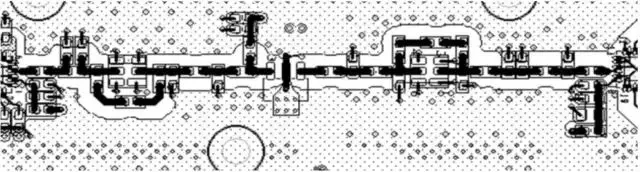
Figure 1. Line-shape layout
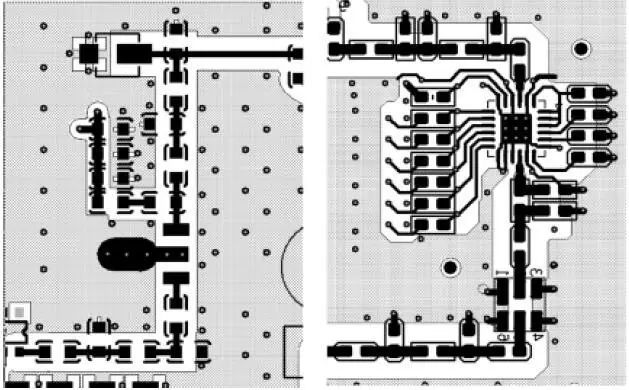
Figure 2. L-shape and U-shape layout
In addition, when using L-shape or U-shape layout, do not turn at the turning point just after entering the interface, as shown in Figure 3 on the left. Instead, turn after a short segment of the line, as shown in Figure 3 on the right.
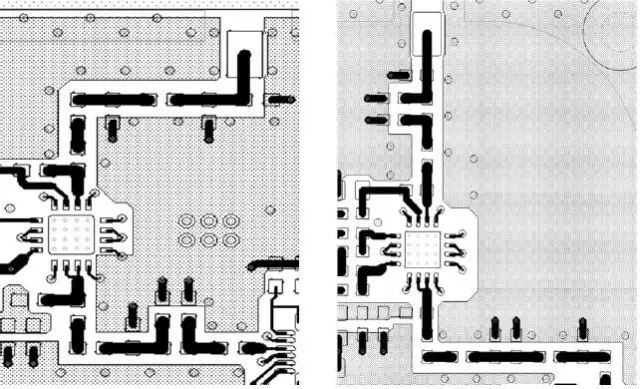
Figure 3. Two plans
The same modules must have the same or symmetrical layout, as shown in Figures 4 and 5.
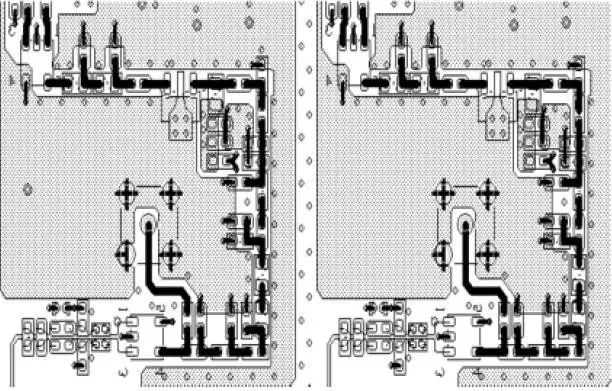
Figure 4. Same layout
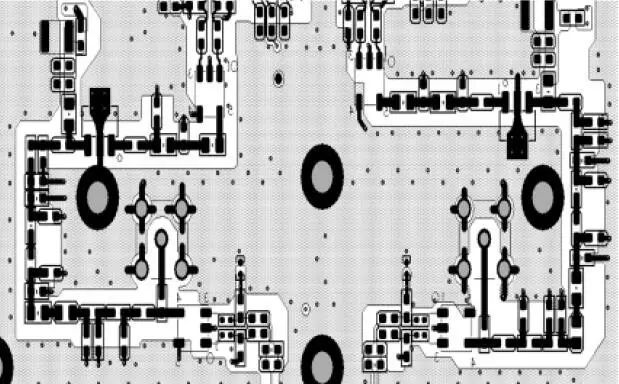
Figure 5. Symmetrical layout
The bias circuit’s feed inductance is placed vertically with the RF channel, as shown in Figure 6, to avoid mutual inductance between inductive devices.
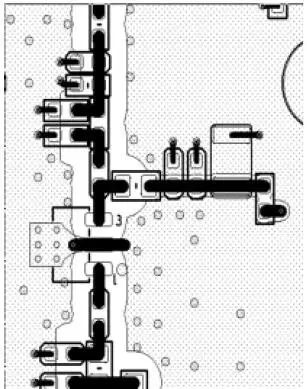
Figure 6. Cross layout
To make rational use of space, the components are arranged in a 45-degree direction to keep the RF line as short as possible, as shown in Figure 7.
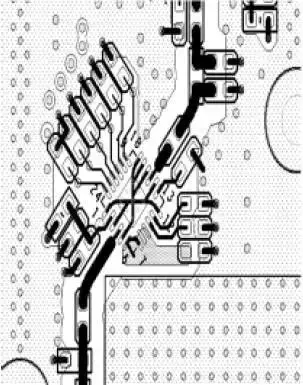
Figure 7. 45° layout
RF wiring requires keeping the RF signal line short and straight, reducing line transitions, minimizing the number of vias, avoiding intersections with other signal lines, and using ground vias around the RF signal path.
Here are the key optimizations:
When the RF line width is much larger than the pin width of an IC device, the line width of the contact chip must adopt a gradual approach, as shown in Figure 8.
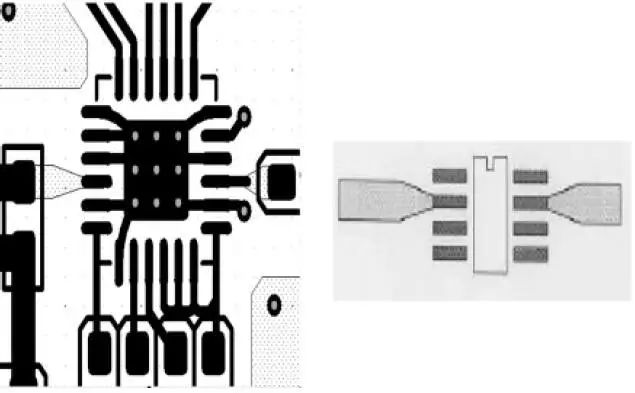
Figure 8. Gradient line
When the RF line is not straight, circular-arc processing is required to reduce the RF signal’s external radiation and mutual coupling. Arc-line routing reduces signal discontinuities and improves RF performance. See Figure 9.
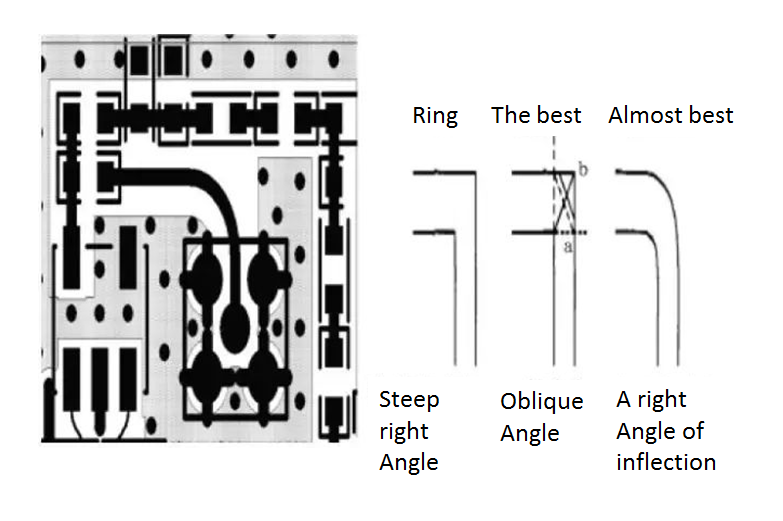
Figure 9. Arc line
Use a thick ground wire. Ground planes must be arranged on multiple layers to reduce impedance, and the ground must be connected to the main ground with additional vias to lower ground impedance.
RF circuit power must avoid plane segmentation; large uninterrupted power planes affect RF performance and are susceptible to RF interference. The power line or plane must adopt the shape of a long strip, processed according to the size of the current. It must be as thick as possible under the premise of meeting current capacity, but cannot be widened without limit. When dealing with power lines, avoid loops.
The direction of the power line and ground must be parallel to the direction of the RF signal, but must not overlap. Where there is a cross, a vertical cross is required.
RF and IF signals cross each other, and space must be maintained between them.
When RF signals cross with other signals, arrange a layer of ground connected to the main ground along the RF line between them. If that is not possible, they must cross at right angles. Other signals in this case also include the power line.
Ground processing of RF signals, interference sources, sensitive signals, and other important signals improves the anti-interference ability of the signal and reduces interference to other signals. See Figure 10.
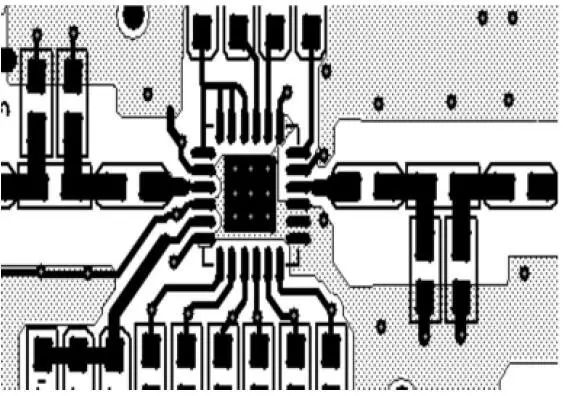
Figure 10. Packet processing
Smooth copper routing and avoiding sharp corners are required in RF PCB design. Where sharp corners or slender copper traces are present, additional vias must be placed at the edges to improve grounding.
Maintain 3W spacing between the RF line and adjacent ground-plane edges, with no ungrounded through-holes within the 3W range.
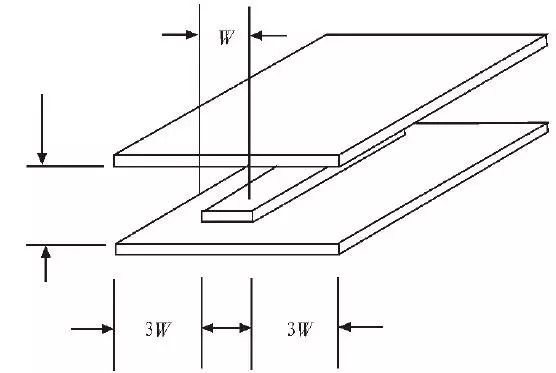
Figure 11. Spacing
The RF lines in the same layer must be grounded and perforated in the copper skin. Via spacing must be designed below 1/20 of the signal wavelength (λ), and the vias must be evenly arranged. The edge of the clad copper skin must be kept at a width of 2W from the RF line or a height of 3H, where H represents the total thickness of the adjacent medium layer.
Capabilities
Payment Methods


Specials Price
Carriers


Support Hobbyist
Certificate


Customer Support
Follow Us